In response to the high degree of uncertainty and compound risks in the healthcare environment, Taipei Veterans General Hospital (TVGH) adopts a systematic approach to identify potential threats, regularly conducts Hazard Vulnerability Analysis (HVA), and implements internal control mechanisms. Together, these measures establish an operational risk management system integrating prevention, monitoring, and response capabilities. Through cross-departmental collaboration and dynamic adjustments, the Hospital continuously strengthens organizational resilience to ensure the stable operation of critical functions.
Hazard Vulnerability Analysis (HVA)
TVGH conducts a Hazard Vulnerability Analysis (HVA) once every four years to identify potential types of disasters, their likelihood of occurrence, and their impacts on human life, property, and continuity of hospital operations. The identified risks are then prioritized. In addition, the Crisis Management Committee and Internal Control Working Group convenes once every six months to review crisis incidents, formulate crisis management decisions, develop concrete improvement measures, and track the effectiveness of corrective actions.
The most recent HVA, conducted in 2023, identified the top five risks as emerging infectious diseases and hospital-acquired cluster infections, IT system disruptions and communication/telephone outages, internal fires, workplace violence/threats, and negative media events. Dedicated units and personnel are assigned to each identified risk to carry out mitigation and preparedness measures. The crisis management plan is also revised, and relevant education and training, emergency response drills, and crisis incident reviews are conducted annually to effectively reduce the likelihood or impact of disasters. Should a disaster occur, the incident is submitted to the Crisis Management Committee and Internal Control Working Group for review.
Internal Control System
In accordance with the Executive Yuan's Directions for Government Internal Control Supervision, each unit conducts an annual rolling risk assessment across four dimensions: Hospital Image, Healthcare Quality and Patient Safety, Achievement of Objectives, and Financial and Property Loss. After the risk levels of internal control items are confirmed and reviewed at the relevant meeting, the Hospital issues its Internal Control System and conducts hospital-wide internal control education and training, unit self-assessments, and filing of the Internal Control Statement. In 2025, five high-risk items and 37 medium- and low-risk items were identified.
| 2025 Risk Matrix | |||||||||||||||||||||||||||||||||||||||
|
Strengthening Public Health Resilience
As a public hospital, TVGH not only continues to optimize hospital management mechanisms and strengthen its professional capabilities, but also systematically considers Taiwan's public health resilience needs. Integrated assessments are conducted across resource allocation, healthcare capacity, and inter-institutional collaboration to ensure readiness for non-routine situations during normal operations, while maintaining service accessibility and operational stability. This further strengthens the healthcare system's overall capacity to adapt, respond, and recover when facing shocks.
Planning the Establishment of the Xinyi Campus
As TVGH enjoys strong public trust, traffic congestion in the Shipai-Tianmu area has become increasingly severe, with frequent congestion during peak hours. With major companies such as NVIDIA expected to move into the Beitou-Shilin Technology Park, traffic conditions may worsen further, affecting not only patient access to medical care but also regional support and deployment in the event of major disasters, such as mass-casualty incidents.
Statistics show that 42% of TVGH patients residing in Taipei City come from southern Taipei, requiring long and inconvenient journeys for care. Taking into account regional service quality and the resilience of medical resources, the Hospital therefore plans to develop the Taipei Veterans General Hospital Xinyi Campus and relocate some outpatient services, scheduled examinations, and outpatient treatments to southern Taipei to relieve traffic pressure in the Shipai area.
With support from the Veterans Affairs Council and approval from the Executive Yuan, and subject to financial affordability, the Hospital acquired four parcels of land on Songde Road and Hulin Street - formerly the site of the Veterans Service and Technical Center under the Veterans Affairs Council - through a 20-year installment payment plan. The future Xinyi Campus will not provide emergency or inpatient services. Instead, its service development will focus on outpatient treatments that do not require hospitalization, smart healthcare, health examinations, and international medical services. It will also undertake cooperation and exchange missions related to veterans' medical services. Upon completion, the new campus is expected to usher TVGH into a new era.
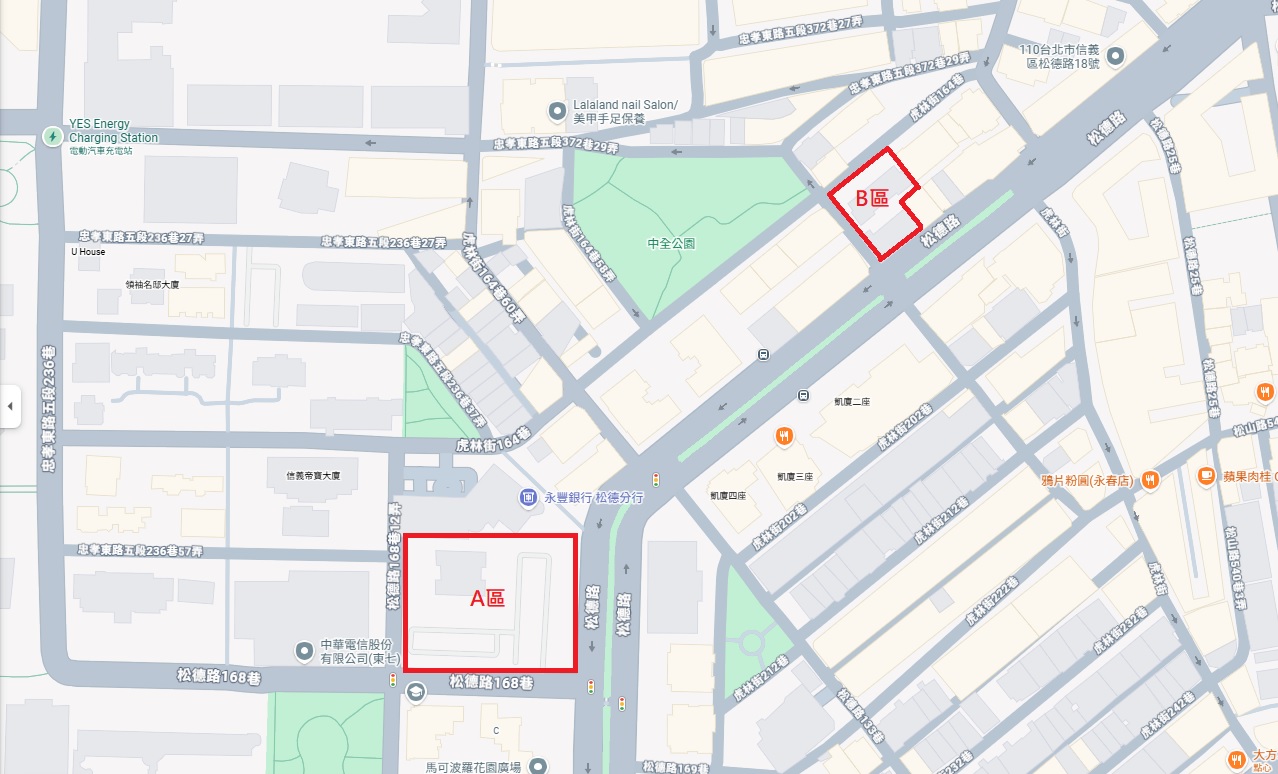 |
| Proposed Site of the Xinyi Campus (Songde Road and Hulin Street) |
Emergency Response Drills
The Hospital has established an effective emergency notification system, together with response measures and emergency mobilization teams for common natural disasters, man-made disasters, emerging infectious diseases, and mass-casualty incidents. When an actual disaster occurs, the affected unit or responsible unit initiates immediate response actions. When necessary, the Hospital Incident Command System (HICS) is activated to carry out disaster response, recovery, and restoration tasks. Following the incident, a root cause analysis is conducted, and mitigation, prevention, and preparedness measures are developed to reduce the likelihood of recurrence.
To strengthen preparedness against emerging infectious diseases, in 2025 the Hospital conducted a Patient Transfer Route Drill for a Suspected Ebola Virus Infection, demonstrating the full process for a patient with a high-consequence infectious disease (HCID), from identification through admission, treatment, and transport. TVGH has long invested in infection control and is equipped with dedicated negative-pressure isolation rooms and intensive care units, as well as standardized procedures. The drill assessed cross-departmental collaboration and enhanced the healthcare team's practical capabilities in protective equipment use, staffing coordination, infection control, and patient safety. The Hospital will continue to conduct education and training and send personnel to the United Kingdom, the United States, and Singapore for professional exchanges, drawing on international experience to strengthen epidemic prevention capacity.
.jpg) .jpg) |
| Ebola Virus Case Management Drill |
Precision Training for Emergency Care Personnel
Heart disease, hypertension, and accidental injuries have long ranked among the ten leading causes of death in Taiwan. In emergencies, seizing the golden window for rescue is critical, making the advancement of first-aid training an urgent priority. However, traditional training manikins ("Annie") are bulky and expensive, making basic life support training difficult to popularize. In response, the Department of Medical Education and the Department of Emergency Medicine collaborated with the Department of Nursing and the Information Management Office to form an R&D team. The team developed two innovative emergency training systems - Arong and TVGH MegaCode AI Master - overcoming limitations of time, location, and distance and enabling users to practice independently anytime and anywhere.
The R&D team integrates artificial intelligence (AI) and Internet of Things (IoT) technologies. When Arong is used with an iPad, the screen intuitively displays whether chest compression depth and rate meet the required standards and guides users on the correct placement of a simulated AED, enabling trainees to quickly master proper first-aid techniques and procedures. The system supports both training and assessment. TVGH MegaCode AI Master, meanwhile, operates in a format similar to a multiplayer online game. Training includes five distinct roles, with participants logging in from their own mobile phones for remote training and review, thereby building team coordination and improving training efficiency.
.jpg) .jpg) |
| Arong Emergency Training Module Used with an iPad for Training and Assessment |
 |
| TVGH MegaCode AI Master Provides Five Role-based Training Tasks for Emergency Response Teams |
The Arong emergency training module and TVGH MegaCode AI Master were developed to efficiently train emergency medical personnel. The systems have received recognition from the 25th National Healthcare Quality Award (NHQA) and the 22nd Academic and Research Innovation Award. They have also obtained a utility model patent, completed technology transfer, and are scheduled for market launch in 2026. Going forward, the training systems are expected to be expanded to healthcare professionals and medical institutions nationwide and gradually introduced into communities and schools, enabling every learner to become a guardian of life at critical moments.
Last Modified: