Hospital Administration
In response to the rapidly changing healthcare environment, the introduction of smart technologies, and rising public expectations, the management of a medical center encompasses multiple dimensions of governance. Through institutionalized management mechanisms and cross-departmental coordination, the Hospital has established a model that combines professional division of responsibilities with integrated collaboration, ensuring that decisions appropriately balance efficiency, quality, and risk control, thereby maintaining stable operations and strengthening the capacity for sustainable development.
TVGH Governance Structure
The sustainable development of a hospital depends on sound hospital governance. The President serves as the highest governing authority of Taipei Veterans General Hospital (TVGH), supported by five Vice Presidents and one Chief Secretary, who jointly oversee 40 operational units and nine supporting units. Senior executives are appointed in accordance with relevant civil service laws and regulations, including the Civil Service Employment Act, the Act Governing Personnel Management of Medical Care Personnel, and the Civil Service Promotion Act, based on the principles of expertise, professionalism, appropriate placement, and fitness for position.
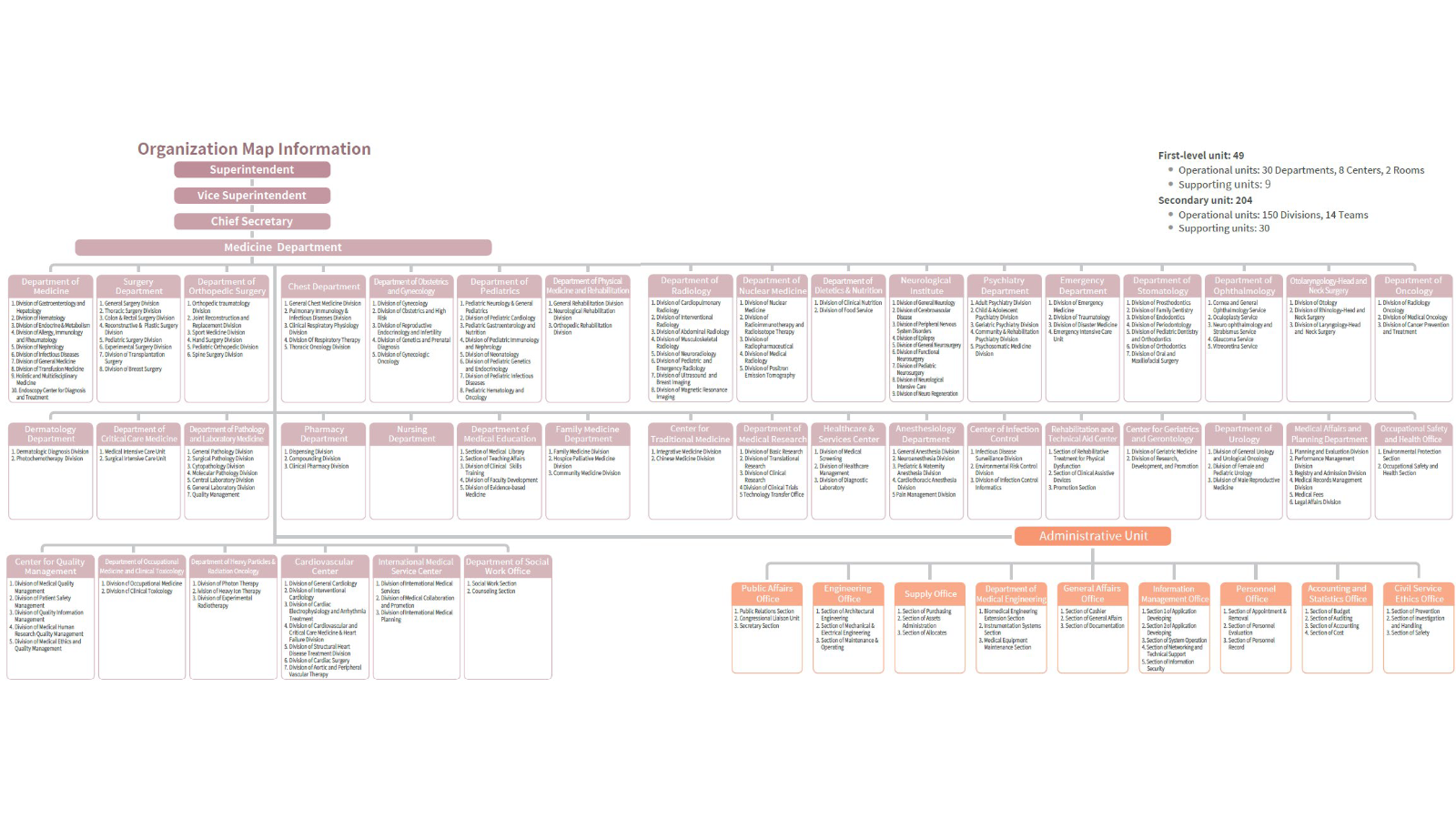 |
| TVGH Organizational Structure |
The President of TVGH serves as the Hospital’s highest governance decision-maker and convenes the Hospital Administrative Meeting each month to review and discuss issues including medical services, hospital governance, environmental sustainability, and social responsibility. The President makes the final decisions and issues directives. In 2025, the Hospital Administrative Meeting tracked the implementation of 99 directives and resolutions, of which 77 were closed and 22 remained under ongoing monitoring. To further embed the concept of sustainable development into hospital governance, first-level units take turns delivering ESG-focused presentations at meetings of the Sustainable Development Committee and the Hospital Administrative Meeting, sharing implementation results and improvement measures to promote cross-departmental exchange and the transfer of experience.
To effectively lead the Hospital in responding to a rapidly changing healthcare environment and major challenges, the President and Vice Presidents strengthen their decision-making capabilities and risk management perspectives through continuing education and training each year. In 2025, the President completed a total of 59 hours of training, while the five Vice Presidents completed a combined 642 hours. Training topics included crisis management, information security, environmental education, and gender mainstreaming. For information on the knowledge and competencies of the Hospital’s governance team.
Communication of Material Incidents
TVGH defines material incidents as stakeholder feedback cases involving an amount of NT$1 million or more, occupational fatalities, incidents reported in the news media, and medical accidents or medical disputes reported to the competent health authorities. All material incidents are promptly reported to the President by the responsible units.
In 2025, one media-reported incident involved a Hospital employee who was indicted by prosecutors on suspicion of corruption, malfeasance, document forgery, and related offenses. The Hospital cooperated with the prosecutors’ investigation. During the same year, the Ethics Office handled 35 ethics-related cases arising from public reports and cases referred or assigned for investigation by the Hospital’s leadership (including higher-level authorities). By case type, these comprised 21 cases of mismanagement, three cases involving employee discipline, four cases involving physician–patient relations, two cases of suspected corruption or malfeasance, and five cases involving other unlawful conduct. All investigations were conducted in accordance with the Administrative Procedure Act, the Whistleblower Protection Act, and the Directions for the Executive Yuan and Its Subordinate Agencies on Handling Public Petitions. Necessary confidentiality measures were implemented throughout the process to protect the identities of informants and prevent subsequent adverse consequences or inconvenience.
| Material Incident in 2025 | Response |
| One media-reported incident involving an employee indicted by prosecutors on suspicion of corruption, malfeasance, document forgery, and related offenses. | The Hospital cooperated with the prosecutors’ investigation. |
Performance Oversight
The President and Vice Presidents of TVGH are selected by the Veterans Affairs Council (VAC). Candidates are drawn from current personnel proposed for promotion or externally recommended candidates who meet the qualification requirements specified in Point 4 of the Regulations Governing the Selection Qualifications and Terms of Office for Medical Personnel Concurrently Serving as Heads, Deputy Heads, or Heads/Deputy Heads of Medical Units at Medical Institutions Affiliated with the Veterans Affairs Council, and are submitted to the Minister of the VAC or the Executive Yuan for approval, as applicable. The President, Vice Presidents, and Chief Secretary each serve a three-year term and may be reappointed once.
Each year, the VAC conducts performance evaluations of the President and Vice Presidents in accordance with the Directions for Performance Evaluation of Heads and Deputy Heads of Affiliated Medical Institutions. The evaluation covers four major dimensions: Operating Performance, Improvement of Administrative Management Efficiency, Policy Alignment, and Major Meritorious or Adverse Incidents. The total evaluation score serves as the performance rating for the heads and deputy heads of each medical institution and is an important basis for annual performance appraisal, reappointment, extension of tenure, and reassignment.
 |
| Four Dimensions of Performance Evaluation for the President and Vice Presidents of TVGH |
The Hospital’s remuneration structure comprises statutory remuneration and operating performance bonuses. Civil servant remuneration is administered by the Personnel Office in accordance with applicable government regulations, while remuneration for contract personnel is implemented upon approval by the supervising authority. The Hospital has no independent remuneration committee. Statutory remuneration is provided in accordance with the Civil Servant Remuneration Act, the Regulations Governing Additional Pay for Civil Servants, and the Executive Yuan’s Directions on Remuneration for Military, Civil Service, and Teaching Personnel. Operating performance bonuses are awarded based on work performance evaluations under applicable VAC rules.
Last Modified: