Next-Generation Digital Healthcare
As a national medical center, TVGH pioneered the establishment of the nation’s first Smart Healthcare Committee. Over the years, the Hospital has been actively responding to the Ministry of Health and Welfare’s Next-Generation Digital Healthcare Platform Project and fully collaborating on the construction of the digital healthcare ecosystem. The Hospital aims to foster cross-disciplinary collaboration to comprehensively enhance healthcare care service quality, accelerate biomedical research innovation, and implement personalized health management. At the same time, the Hospital actively empowers the development of Taiwan’s smart healthcare industry, enabling it to achieve leading advantages and sustainable competitiveness in the global market.
Pioneer in Healthcare Digital Transformation
TVGH leads the development of medical AI and smart hospitals, and officially launched the first cluster-based supercomputing platform, “TVGH Cloud 1”, in Taiwan’s healthcare system in the end of 2023. This platform significantly improves the computation efficiency of the Hospital’s massive medical data analysis, predictive model construction, AI model training, and clinical decision support. By empowering precision medicine, disease prognosis prediction, genomic sequence analysis, digital pathology-based precision diagnosis, intelligent drug development, and innovative applications of generative AI and large language models, this initiative marks a key milestone in the Hospital’s digital transformation and symbolizes a breakthrough in Taiwan’s high-performance computing in medicine. In response to the growing scale and diversity of clinical research demands, the Hospital will continue to enhance its on-premises computing capabilities, data governance, cybersecurity controls, and model service capabilities. The Hospital will also progressively expand computing resources and upgrade infrastructure to establish a comprehensive smart healthcare ecosystem.
Along the journey of AI development, the Hospital has steadily transitioned from the research and development phase into a new stage of governance and expansion. In addition to continuously optimizing the full-process smart healthcare services, including registration, consultation, payment, and medical record access, the Hospital has implemented more than 60 AI-related projects as of 2025. Among them, more than 20 of these applications have already been implemented in clinical and medical practice, covering areas such as image-assisted interpretation, acute medical applications, disease risk prediction, mental health care, digital pathology, smart chronic disease care, and clinical decision support. In the future, TVGH will uphold the core principles of Responsible AI by integrating data governance, cybersecurity protection, transparency and explainability, fairness and non-discrimination, and human-machine collaboration. These efforts will enhance the clinical value, quality management, and sustainable management benefits of AI applications, thereby driving continuous improvements in healthcare quality and operational efficiency.
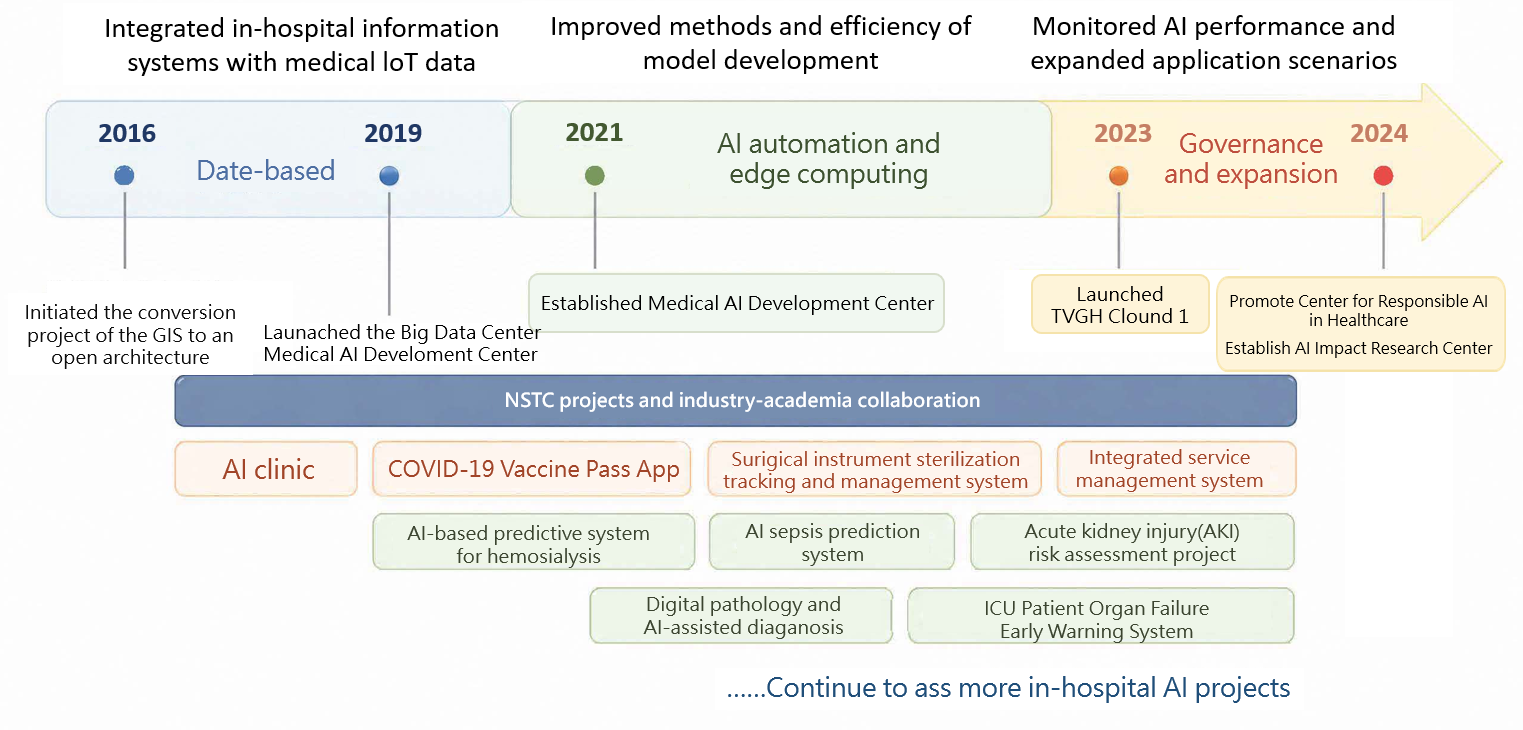 |
| TVGH’s AI technology Development History |
Three Major AI Center Project
TVGH was selected as a responsible hospital for "Responsible AI Execution Center” and the "AI Impact Research Center" program of the Ministry of Health and Welfare’s 2024 Establishment of Three Major AI Centers under the Next-Generation Digital Healthcare Platform. In early 2025, the structure and responsibilities of the Smart Healthcare Committee and the Medical AI Development Center were restructured to simultaneously carry out the three major AI center projects.
TVGH will deepen collaboration among industry, academia, and research institutions to assist technology companies in completing the verification of AI medical devices so as to accelerate technology commercialization. In addition, we will further strengthen the construction of a multi-center medical alliance network to provide diverse real-world scenarios for AI technologies. The Hospital will also participate in the establishment of domestic and international standards for AI application, promote the standardized adoption of smart medical devices, and further expand TVGH’s influence in the global smart healthcare.
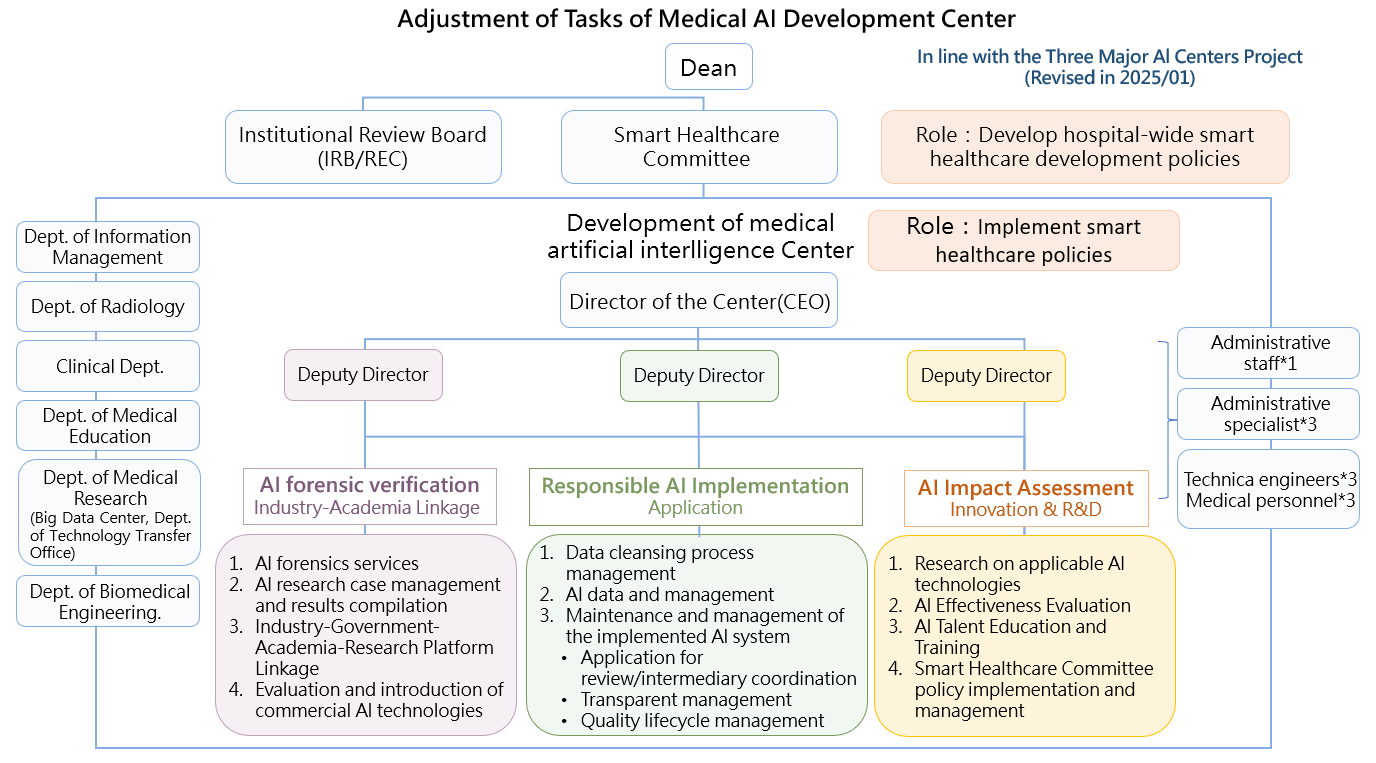 |
| Adjustment of Tasks of Medical AI Development Center |
TVGH’s Responsible AI Execution Center is now working on the management measures for the implementation of AI. In addition, the smart healthcare affairs meeting chaired by the Vice Superintendent for operations is also in place for the discussions of issues related to AI review to ensure the transparency, interpretability, and equity in the deployment of AI systems. It is planned to implement a centralized single-window with digital application forms to streamline and manage trial applications for smart technologies. This platform will serve as review mechanism to ensure AI technologies are used responsibly and comply with the principles of transparency, transparency, and equality.
The core mission of the "AI Impact Research Center" is to promote inclusion of AI-based products in national health insurance and commercial insurance reimbursement schemes, thereby accelerating their practical application and overall impact within the healthcare system. To this end, the center will adopt multiple strategies, including the implementation of a single window platform, the design of a standardized trial application process, the provision of user guidelines along with feedback channels to improve the overall convenience and efficiency of research applications. By launching multiple clinical trial projects for AI products, we aim to analyze the medical benefits and economic impact through randomized controlled trials (RCTs) and observational research. A health economic benefit report will be presented to the National Health Insurance Administration based on the results of these trials to support the review of health insurance benefits and the formulation of pricing standards.
Deepening Engagement in the Healthcare Industry
Taipei Veterans General Hospital signed an MOU (Memorandum of Understanding) with Chunghwa Telecom in 2024, and has established a 5G Medical Demonstration Field. In addition, the AI-driven Predictive Model for Dialysis Safety developed was won the 2025 Future Tech Award. This year, both parties have worked together once again to promote NSTC’s Smart Healthcare Industry-Academia Alliance Project. With the core AI model developed by TVGH and the technical support provided by Chunghwa Telecom, a Telehealth Center is planned to be established to develop an integrated telehealth ecosystem by advancing telemedicine services and intelligent early warning mechanisms to improve healthcare quality and accessibility, while accelerating the realization of a sustainable health vision.
 |
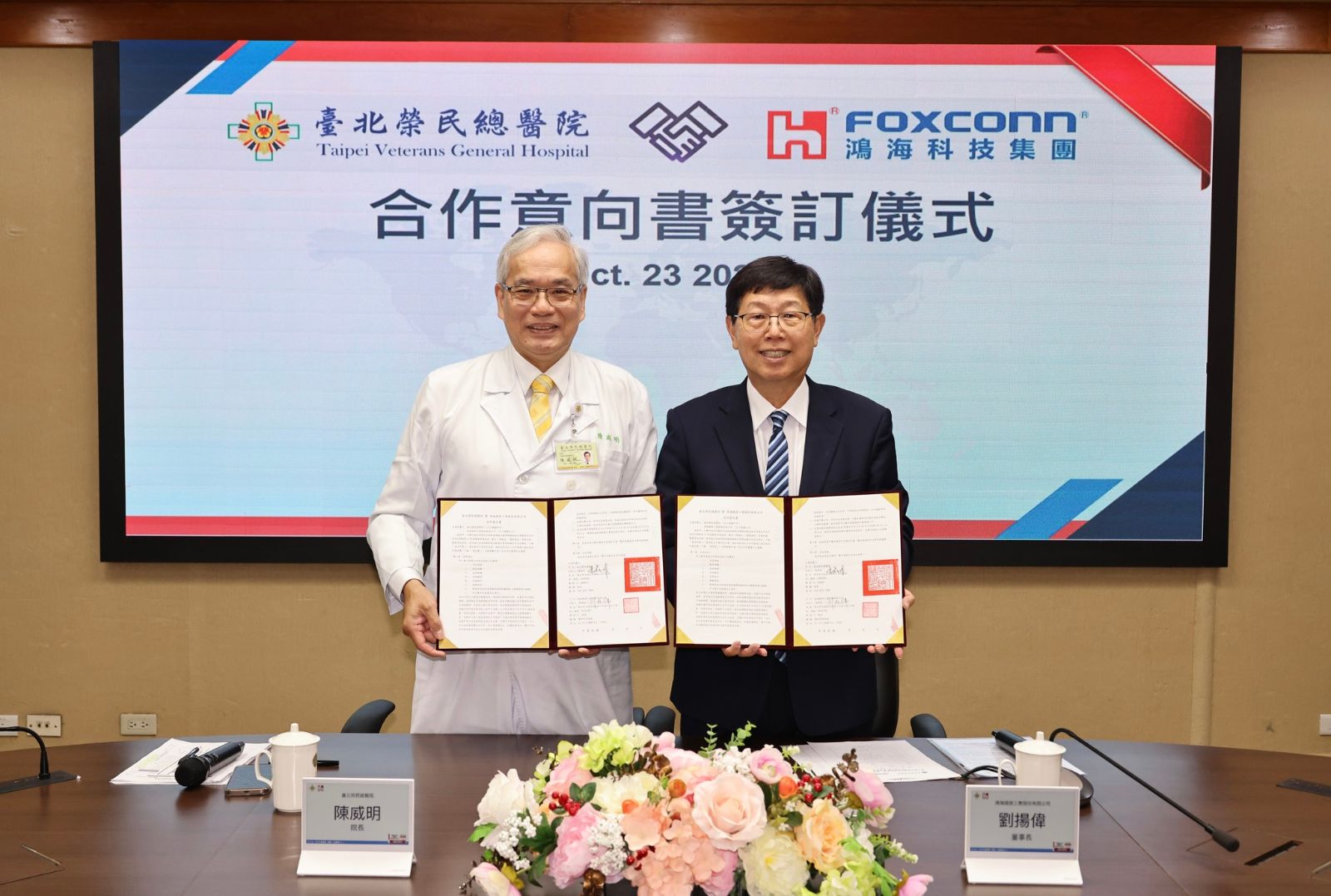 |
| TVGH’s smart healthcare team visited Chunghwa Telecom | TVGH signed an MOU with Hon Hai Technology Group |
Hon Hai Technology Group is globally recognized for its industry-leading manufacturing quality and operational efficiency and has actively expanded into the field of AI-powered smart healthcare in recent years. At the end of 2025, Taipei Veterans General Hospital signed an MOU on Strategic Cooperation in Smart Healthcare with Hon Hai Technology Group, which also donated NT$ 300 million to fund related research projects. Both parties will establish a Smart Innovation Research Lab on the sixth floor of the TVGH Technology Building to jointly carry out comprehensive cooperation in clinical process automation, AI multimodal medical model development and verification, smart robot introduction and telemedicine applications, creating a smart healthcare demonstration base.
This collaboration is not only a partnership between Hon Hai Technology Group and Taipei Veterans General Hospital, but also a powerful alliance of "Taiwan, TTVGH, and Hon Hai," combining "depth of medical expertise" with "breadth of technology" to create new possibilities for smart healthcare in Taiwan.
Healthcare Information Security Environment
As smart healthcare continues to evolve, healthcare systems are becoming highly digitalized through the widespread adoption of AI-assisted decision making, cloud computing, and inter-hospital data exchange. As a result, the volume and sensitivity of electronic medical records, medical images, and real-time monitoring data have increased substantially. Therefore, information security has to be upgraded from traditional system protection to the core foundation supporting the stable operation of medical services. As a national medical center with an annual service volume of 2.45 million outpatient visits, 130,000 inpatient visits, and approximately 70,000 surgical visits, TVGH faces up to 1.7 million attempted cyberattacks on a daily basis, which has become a key battlefield for cybersecurity attack and defense.
Information Security Management and Controls
As a government agency with Level A cyber security responsibility defined in the Cyber Security Management Act, TVGH has formulated and implemented the Cyber Security Maintenance Plan. To ensure the confidentiality, integrity, and availability of information assets and to comply with relevant laws and regulations to prevent intentional or accidental treats internally or externally and safeguard the rights and interests of our stakeholders, we have introduced an Information Security Management System (ISMS) to establish the information security management system through institutionalization, documentation, and systematization. We have obtained CNS 27001 Information Security Standard Certification and complied with the provisions of Cyber Security Management Act for effectively control of information security risks of the Hospital.
Cyber Security & Personal Data Protection Committee is the highest decision-making unit for cyber security and personal data in the Hospital. The Vice Superintendent supervising information business serves as the Chief Information Security Officer (CISO), overseeing the Information Security Team, Personal Data Team, Internal Audit Team, and Incident Reporting and Response Team, which are responsible for promoting information security and personal data protection affairs. The committee is convened at least twice a year to support and effectively supervise the promotion and implementation of related affairs. Each team will work on the promotion of information security and personal data protection in terms of management, technology, and cognitive education and training.
.png) |
| Organizational Structure of Cyber Security & Personal Data Protection Committee |
.png)
National-level Cybersecurity Defense
Based on the characteristics and importance of the institution, TVGH was included in the first-tier national critical infrastructure (CI) as early as 2016, with the same protection level as that of the Ministry of National Defense. It is under the security protection inspection of Executive Yuan's Office of Homeland Security. The Hospital conduct a comprehensive assessment based on the CI Self-Security Protection Checklist and follow the Guidelines for National Critical Information Infrastructure Protection for the development of a comprehensive cybersecurity protection plan. With the comprehensive adoption of the Zero Trust Architecture (ZTA) principle, a complete and full cybersecurity lifecycle protection mechanism from prevention, preparation, response to recovery has been established, meeting and implementing the high-standard protection requirements of the Center for Internet Security and ensuring the stable operation of medical services and the security protection of patient data.
In terms of cross-agency cybersecurity defense collaboration, following the signing of the Cybersecurity Support Agreement with the Taipei City Field Division, Investigation Bureau of the Ministry of Justice (MJIB) in 2021, TVGH further signed the Memorandum of Understanding (MOU) on National Information Security Joint Defense and Information Sharing Cooperation with MJIB in May, 2024. Through the national-level strategic alliance, we can substantially reinforce information security protection, achieve remarkable results in early warning, effective prevention, emergency response, comprehensively block digital crimes and build a solid digital defense resilience.
Cybersecurity Incident Response
TVGH Information Team maintains the communication with Investigation Bureau of the Ministry of Justice (MJIB), conduct confrontation drills with each other, and cooperate with the joint defense on specific issues to achieve early-stage prevention. Through cybersecurity joint defense and intelligence sharing, both parties can respond promptly and provide timely coordination in the event of any incident, thereby preventing harm and mitigate any subsequent impact, ensuring information and communication security, responding to the government policy of “cybersecurity is national security”, and maintaining the medical capacity of the Hospital to serve its purpose of taking care of the people.
There were no information security or data breach incidents in 2025. In the face of an information security incident, the Chief Information Security Officer (CISO) or the Director of the Information Office serve as the incident commander, and the Incident Reporting and Response Team shall respond in accordance with the reporting and response procedures stipulated in the “Information Security Incident and Personal Data Breach Reporting and Response Management Procedures”.
.png) |
| Information Security Incident Reporting and Response Process |
The Incident Reporting and Response Team is divided into “News Group”, “Intelligence and Planning Group”, “Response Execution Group”, “Logistics Coordination Group”, and “Financial Administration Group”. These groups are in charge of external news release or explanation, information security and personal data breach incident notification and intelligence sharing, development of response strategies and plans, carrying out damage control and recovery operations, preserving and retaining evidence, finding the root cause of the incident, coming up with suggestions for improvement, conducting follow-ups and reviews, assisting with improvement reports.
Smart Healthcare Application Outcomes
The application of AI in healthcare innovation has become a global trend. TVGH continues to integrate clinical needs, engineering expertise, and data governance capabilities through systematic implementation and cross-disciplinary collaboration mechanisms to facilitate the transition of innovative technologies from R&D to clinical practices, establishing a patient-centered smart healthcare application ecosystem and ultimately improving the public health.
Innovative R&D Achievements
Taipei Veterans General Hospital participated in the Taiwan Innotech Expo (TIE) 2025 co-organized by 11 government ministries and agencies, including Ministry of Economic Affairs, National Science and Technology Council, Ministry of Agriculture, Ministry of National Defense, Ministry of Education, Ministry of Labor, Ministry of Health and Welfare, Ministry of Environment, Ministry of Digital Affairs, National Development Council, and Academia Sinica, and TVGH stood out from 1,110 cutting-edge technologies from 439 domestic and foreign enterprises and academic research institutions in 19 countries and won two major awards.
The Department of Nuclear Medicine and the Department of Biomedical Engineering jointly developed an “AI-driven automated radiopharmaceutical dispensing system”, which won the Gold Award in the Expo. This system is capable of autonomously performing the entire radiopharmaceutical preparation process, including dose withdrawal, dispensing, and packaging in an unmanned environment, establishing a new benchmark for zero-exposure safety. The Department of Internal Medicine Team’s "AI-based Real-time Hemodialysis Monitoring and Early Warning System" is capable of providing early warnings of dialysis risks 15 to 75 minutes in advance, allowing the medical team to respond promptly and protect patient safety. This system has been recognized by the National Science and Technology Council's "2025 Future Tech Award."
.jpg) |
.jpg) |
| AI-driven automated radiopharmaceutical dispensing system | The Department of Internal Medicine Team was honored with the Future Tech Award |
In addition, we also won six awards at the 22nd National Innovation Award, including FaceHeart CardioMirror, AI-assisted Breast Cancer Interpretation, Hybrid Method for Peritoneal Dialysis Catheter Insertions, Integrated Preclinical Platform for Hereditary Hearing Loss Gene Therapy, TVGH MegAiCode Master, and Innovative Gene/Small Molecule Drug Delivery Platform, demonstrating TVGH’s firm commitment to continuously promoting internationally competitive healthcare innovation.
Acquisition of Patents in Multiple Countries
Schizophrenia is a severe chronic psychiatric disorder with a global prevalence of approximately 1%. Its pathogenesis involves abnormalities in neurotransmission, alterations in brain structure, and functional decline. However, due to the long-standing lack of objective diagnostic tools for psychiatric disorders, clinical assessments have mostly relied on behavioral observations and subjective interviews, making it difficult to fully evaluate the condition and brain changes, thus restricting the potential for precision-based interventions.
Brain Probe, an AI-powered smart brain imaging platform, developed by TVGH’s Department of Psychiatry integrates MRI imaging and deep learning algorithms to successfully establish brain aging prediction indicators and lesion change tracking mechanisms. It can accurately locate abnormal areas in the brain and, through its three-dimensional visualization function, assist physicians in interpreting and communicating the condition in depth with patients and their families. It also features MRI-guided navigation, enabling the further development of precise non-invasive neuromodulation techniques, such as transcranial magnetic simulation (TMX), as supportive tools for clinical care.
Brain Probe has won multiple awards, including NSTC’s Future Tech Award, IBMI’s National Innovation Award, Y. Z. Hsu Technology Invention Award, JCT’s Gold Award for Outstanding Clinical Service, and Edison Awards, and has obtained patents in multiple countries, including Taiwan and the U.S., and international patent cooperation treaties (PCT). The Smart Body-Mind Innovative Treatment Area has been established and in operation at TVGH, marking a breakthrough in the transition from subjective judgement to scientific assessment in psychiatry, benefiting individuals with mental disorders while advancing the development of psychiatry in Taiwan.
Cross-Border, Multiple-Center Implementation of Evidence-Based Practices
Pulmonary hypertension affects over 25 million people worldwide. Due to its subtle early symptoms and lack of timely and convenient screening tools, diagnosis is often delayed, making it a cardiopulmonary disease with a high mortality rate. The cardiology teams of Taipei Veterans General Hospital and Taichung Veterans General Hospital collaborated with the Institute of Biomedical Sciences, Academia Sinica, and Japanese medical institutions to complete the world's first cross-border, cross-center validated "Electrocardiogram-based Pulmonary Hypertension Detection System" with the support of funding from the NSTC’s Taiwan Smart Healthcare Alliance (TSHA). This system has not only won the "Clinical Innovation Award" in the 20th National Innovation Award but also been certified by the Food and Drug Administration (TFDA) of the Ministry of Health and Welfare, allowing it to be officially used in clinical diagnosis.
.jpg) |
| The Pulmonary Hypertension Detection System was honored with the Clinical Innovation Award in the National Innovation Award |
The Pulmonary Hypertension Detection System integrates AI with electrocardiogram (ECG) analysis technology, featuring low cost, high efficiency, and broad applicability. Without the need for additional clinical parameters, it requires only a standard ECG machine and a personal computer for the system to complete analysis within 5 to 10 minutes. This system has been successfully validated in Taipei Veterans General Hospital, Taichung Veterans General Hospital, National Cheng Kung University Hospital, and Makiminato Central Hospital as well as Nakagami Hospital in Japan, and has been successfully applied to various electrocardiogram (ECG) models.
Currently, the Electrocardiogram-based Pulmonary Hypertension Detection System has already been implemented in actual clinical settings and will be actively promoted for application in the primary healthcare market as an important tool for national health prevention. In the future, it can also be included in the National Health Insurance and national health check-up programs to further reduce medical expenses and social burden.
Last Modified: